domenica 28 giugno 2009

The watermelon, "u muluni" and "gelo di mellone".


The dialect term “muluni”, or "Mellone" which in Italian is said anguria, is the watermelon.
In Sicily, simply turn to the countryside and see the great production, to understand the great love that is devoted to this fruit.


In Palermo you can enjoy the watermelon in one of the many kiosks in the city (and even near the sea), to the Foro Italico, the Cala, Corso Alberto Amedeo, etc,


where you can eat a huge slice of this fruit and truly in this case its exquisiteness is ensured.


"U muluni" can not miss during the feast of Santa Rosalia, where the people eat watermelon and “babbaluci” (snails seasoned with garlic and parsley.

By the watermelon is produced a delicious cake, “gelo di mellone”, which probably is originated from the "arberesch", coming from Albania and which has Arabic influences (the ingredients are, as well to the watermelon , cinnamon and jasmine).


Recipe:

Ingredients: 1 liter of water melon juice, 80gr starch, 200gr sugar, 1 sachet of vanilla, 1 stick of cinnamon, 1 tablespoon of holes jasmine, chocolate drops, pistachios.

Processing: Remove the peel and the blacks seeds and put in the blender the watermelon. Put in infusion the jasmine flowers in a little hot water. Put in a pot on the juice of watermelon, add the starch and dissolve it in cold. Add sugar, cinnamon and vanilla, turn on the cooker and mix, bring to boil, when it thickens turn off the fire and add the water of the jasmine. Pour into cups, to cool and then put in the fridge. Serve decorating the cups with cinnamon, chocolate drops, crushed pistachio and a jasmine flower.

sabato 30 maggio 2009

Boiled octopus, "Purpu vugghiutu".

Among the foods most loved by people of Palermo in the summer when they go in the maritime areas surrounding the city, is the boiled octopus that we say "purpu vugghiuto".


In the square of Mondello were lots of shacks of "purpari" (men that cooks the octopus), where you could buy this delight of the sea. Certainly these shacks had obstructed the view of the sea and was not always possible to ensure compliance with all rules of hygiene (as is the case for almost all the food street of Palermo).

It was for this reason that in the mid '80s all the stalls of the purpari were removed from the square of Mondello, with the protests of those who so loved to taste the octopus hot, feeling the scent of the sea. Admittedly,the shacks in sheet were really bad, but had a special charm, popular, and were a source of attraction for people of Palermo, but also for tourists that loved this folklore.


As for the hygienic issue, the people of Palermo would not have too many problems, since we have the stomach immunized from all things, thanks to years of training to the more bizarre foods, heavy and in places not always clean ...

certainly not for the tourists, in their case a "true test of courage ", although I must say that I have never heard of people who have had problems with our food!Returning to the "purpari" of Mondello, some of these have moved within the restaurants to continue their historical activities.

The Boiled octopus can be found too at Sferracavallo (with urchins and mussels), in the village of Romagnolo (also various shacks were torn down) and sometimes also in the historical markets of Palermo.


The "purpari" made boiled the octopus in the pot (the most traditional clay) filled with sea water, and then served it on ceramic dishes accompanied only by a dash of lemon. They had a ritual in the cook and serve, and a great skill in choosing the most tender (females) or more valuable (the MAIOLINO).

photos by Judy Witts


To cook the octopus, there is a "secret", you should boil the water (salt abundantly, because is not so easy to use directly the sea water) and immerse octopus (previously washed) take it for the head (which is the stomach), on three times, immersing it and exiting it by the water.
I think this trick have a purely aesthetic grounds, to curl the tentacles "the granfe" upwards, but no one palermitano would do it differently.

When the water resumes boiling, we calculate ten minutes (keeping the lid of the pot semi open), then turns off the fire and leave the octopus in water to stay warm for at least an hour, so it will be certainly tender, or at least I hope, because even the art to be a purparo is a real art!

The true fans of boiled octopus, just eat it by adding the juice of the lemon, but is also excellent at salad , cut into pieces and seasoned simply with oil, lemon and fresh parsley.


One curiosity, when the coffee is a little watered down, in Palermo we say "But is it Water of octopus?".

venerdì 29 maggio 2009

Mondello, the beach near Palermo.

photo Jan-Luc Moreau

The most popular place for walks of people from Palermo, what is considered the "Square of Palermo" for the summer, the bathing place of excellence, the place to eat ice cream, and boiled octopus or bread and panelle is Mondello.


Mondello (a few kilometers from Palermo) was originally a fishing village,
nestled in a beautiful bay delineated by a white beach and the blue sea.
In 1891 the area, first marshland, was reclaimed , and they began a work of colonization and the building, due also to an Italian-Belgian company which took the entire concession area. Were built in the early '900 villas in Liberty style ,
and a huge " establishment bathing" that became the summer destination for the most privileged of Palermo.


Mondello today is a busy place, full of restaurants and paninerie, ice cream shops, kiosks, shops etc.. In summer you play sports and musical events.
The beach in the spring or early summer is wonderful, during the summer becomes crowded, because in large part is occupied by "bathing boxes" of wood colored with white and blue.
Is a place of aggregation for the younger ones that especially when approaching the summer season don't go to the school.

What makes Mondello very special, apart the beach and the sea, is the beautiful port with its colorful boats,
pines and palms that adorn the waterfront,
but also the architecture of the villas
(including the infamous and uninhabited villa "bewitched" that nobody would dare to go inside), which gives a special charm to this place that really deserves a visit.

And then at the end of Mondello, there is Chief Gallo is a natural reserve of great beauty ... but this is a new topic ....

giovedì 28 maggio 2009

"A pasta chi sardi". Pasta with sardines


The origin of this dish is Arab, the legend tells that was invented by the cook of a general Arab who landed in Sicily was in precarious situations.

To feed the troops, the cook thought to take advantage of what nature offered him, and invented a dish that was enriched over the centuries up to the traditional recipe.

Already the Romans and the Greeks enriched their dishes with wild fennel. And is interesting to the use of pine nuts which has antiseptic qualities, for what was a poor kitchen, where it was difficult to find fresh fish and meat, was intended to avoid some probable poisoning.

photo Judy Witts

"The pasta chi sardi" is one of the most original dishes of Palermo, which combines very different elements, but whose combination is delicious and is a perfect harmony between and sweet and sour typical of Sicilian cuisine of Arabic origin.

photo Judy Witts

There is the blue fish in our seas, there is the dried fruit (sultanas and pine nuts), there is the flavor of wild fennel and the aroma and yellow color of a spice that is so precious, the saffron, all combined with the particular type of pasta, the bucatini, whose characteristic is “to jump on the flat”, and that above all must do the "scruscio" (noise) when the Palermitano eats this pasta with passion!

photo Judy Witts

RECIPE

Ingredients: For five persons
500 g of fresh sardines, 500 grams of bucatini, 500 g of fennel Mountain, 2 medium onions, 3 salted anchovies, 50 g of raisins and pine nuts for many, a sachet of saffron, olive oil, salt and pepper.

Boil for about twenty minutes fennel in salt water, the same that you will use after for boil the pasta (4 liters for 500 g of pasta), drain and chop. Hold by the water. In a pan, cook the sardines just cleaned in 1 dl of olive oil (one minute per side),after, put the cooked sardines in a dish. Use the same pan to sauté with oil the finely sliced onions , then combine aniseed, sardines, raisins, the pine nuts, salt and pepper. Cook over low heat, stirring to mix the sauce. After about twenty minutes, add the anchovies, which were desalted, washed, dried and finally dissolved in a pan with a tablespoon of hot oil. Bake again for 15 minutes, stirring and then add a bag of saffron, dissolved in a tablespoon of water.Putting Meanwhile cook the pasta in the cooking water of fennel. Drain "al dente" (Not too cook) and add it to the sauce.

For this occasion I publish a poem in sicilian dialect (with the English translation) of my mother Emilia Merenda on this dish so original.
A PASTA CHI SARDI
Finuccheddu di muntagna crisciutu ‘n’natura
e poi ci coci la pasta ni’ l’acqua di cuttura
e pi’ li balatara cchiù fini
hannu a essiri sulu maccarruncini.
Passulina e pignoli e ‘na cipudda ‘ngranciata
anticchia ‘i zafaranu e ‘na sarda salata,
l’ogghiu sempri ginirusu
arriminari spissu senza essiri lagnusu.
Poi ‘na manata di sardi frischi e argintati
e dintra la conza vannu ‘mmiscati,
senza spini e allinguati
vasinnò si pò moriri affucati.
La pasta avi ‘a ristari ‘ngridda,
ca’ mentri la manci sata comu n’ancidda
ca’ sulu a talialla è un veru priu
e poi a mancialla iu m’arricriu.
Tu, nun po’ capiri si nun l’ha’ tastatu mai,
ma si la manci, ti fa scurdari i guai.


PASTA WITH SARDINES
Fennel mountain grown naturally
and then cook pasta in the cooking water
and for the most sensitive
should only be maccheroncini.
Raisins and pine nuts and onion browned,
a anchovy saffron and salt,
oil always generous
stir often without being inactive.
Then a handful of fresh "silver" sardines
without thorns.
otherwise you can die suffocated.
The pasta should remain "al dente" (not too cook),
that you can eat, while the pasta jumps in the dish, and is a real pleasure
and then eat it is a satisfaction.
You, you can not tell whether you have ever tasted,
but if you eat, it makes you forget all your troubles.

mercoledì 27 maggio 2009

Portella della Ginestra, near Piana degli Albanesi


In Sicily there are beautiful places to visit because of the nature expresses itself in all its charm and people have left traces of great value.

Places by sea, the beaches. Mountains that seem to draw in the sky, there are many archaeological sites, temples and theaters. And the big cities where churches, theaters, palaces, gardens, expose us the passing of history.

Then there are places significant because tell us about the life and unfortunately also the death of those who have tried to change the course of history, trying to assert positive values and to reappropriate their own destiny.


The place I will tell about here is Portella della Ginestra, a land in the province of Palermo near Piana degli Albanesi.
It is a beautiful silent valley, there are not homes. Everything is covered with a carpet of green grass, with flowers of different types, from the tiny red amaranth,
to those that appear yellow enamelled inside. Cereal wild, sometimes twigs dried thorny. The valley is marked by white rocks that seem sheeps when resting. And then red rock cliffs that seem immersed in a green sea .

In this valley there are voices of struggle, but also of pain.
Portella della Ginestra fact is known for the tragedy that occurred on 1th of May 1947, shortly after the war, when for the first time since the end of the fascist regime, people could celebrate again the day of workers.


Many workers, especially farmers, gathered there to demonstrate against the landowners, for the employment of land, and to celebrate their day, but suffered a cowardly ambush, lots of gusts from miter hidden behind the rocks, they left on that field dead and wounded, including children and adolescents.


I'll not to tell here the different assumptions about the performers and especially the sponsors of this crime, because so many better than me are occupied about this in the years, and because this episode is still partly shrouded by the mystery because involves powers and situations too complex and intertwined with each other. But one thing is certain, that when in the course of its history the bests among Sicilians, workers, honest, on many occasions with many women on the front lines, have sought to reappropriate their lives, to rebel against oppression , to raise his head, the power of the state and "power" of local criminal were allies against them , all together to stop those who wanted and could build a better future.


Now every 1 May Day, people goes again in that green field to demonstrate, and try not to forget the dream and hope of those who tried to change the future.

domenica 24 maggio 2009

Scopello, beautiful sea


When the sun is warm and the sky incredibly blue, starts "the desire of the sea".
I will tell about a wonderful place, that in addition to its natural beauty, it contains in itself also an inexplicable sense of mystery.


Its name is Scopello, is located in the province of Trapani between Castellammare del Golfo and San Vito Lo Capo, one hour away from Palermo.

The courtyard of Scopello is located on a cliff showing a breathtaking view over the sea where there are two rocks that give the name to Scopello, in greek Skopelos means just rocks, and perhaps the Arabs gave to the town the nickname of Iscubul (rock). The small courtyard is formed by a few stone houses and a “Gebbia” (drinking). The atmosphere is serene, pleasant, air wafts a mild smell of sheep's milk.

Above the rocks there is the Torre bennistra of the sixteenth century and the ruins of a Saracen tower.
Higher up the wood of Scopello, which was one of the estates of Ferdinand III of Bourbon.

To add more charm to the place there is the old "tonnara" now disused, which maintains the structures of the past, and stands where once stood the ancient city of Cetaria (city of tuna), which disappeared along with his tonnara, which was then reconstructed by the Arabs.

What makes this place special is the rocky coastline, broken by the bay pebble Guidaloca by an "emerald sea", not far away the beautiful rocks emerging by a crystal clear water and seem to have been placed there by the hand of a giant mythological.

Near Scopello is the reserve of Zingaro, which is a charming place to walk in nature with a beautiful view and the possibility to reach the beautiful bays where you can have a pleasant swim.Of note for the greedy ones, that in this whole area they can eat very well, and above all can taste the fish cus cus.
Until about fifteen years ago, Scopello was still inhabited by a few people in the place, and there were not tourists, I can still remember the pleasant feeling proven, the smells and the taste special to me, a little strange, who had the cream of my giant ice cream cone, due to the milk just milked. Now tourism has grown, there are restaurants and little hotels, but has not transformed the atmosphere of simplicity and serenity that you can still breathe.

sabato 23 maggio 2009

The Lake of "Piana degli Albanesi"


In Sicily the bigger reason of attraction is the sea because we are in an island and so we are surrounded , enveloped, cuddled by the sea. The sea that changes continuously, the coasts always different that follow the perimeter of this triangular land .

Our sea is beautiful, but often neglected, the sea that gives us life and food, the sea that promises future and freedom to those who want escape from an impossible life, but often betrays, becoming a place of death or of deportation. The sea is friend and enemy at the same time, it can be a great tear or a place of friendship.

But today I will not talk about the sea but about a lake. The lake that gives the quiet, the lake that's not enough because is not open and infinite as the sea, but gives us the water for drink, making less arid the lands of Sicily.


The Lake of Piana degli Albanesi, is near a small town (PIana degli Albanesi), about 20 km from Palermo, founded in 1488 by some exiles Albanians fled from their land of origin after to the invasion of the Turkey. At Piana the Byzantine culture mixes with the Baroque, influenced by Pietro Novelli. THe people continue to maintain the original traditions and customs, language Arberesh, greek orthodox religion. In Piana there are the best "cannoli", and there is also a lake.

This is an artificial lake created with a dam crossing the river Belice. This lake is surrounded by a small mountain range whose peaks are the mountains of Maganoce, Kumeta and Pizzuta.
Around the lake overlooking the nature and human technology that made him such. Everything is covered with a green and flowery mantle, there are woods in which to enjoy the shadow. You can relax, or fishing. There is a lot of free space.


You can lie down on grass fresh and enjoy a fantastic landscape, feeling the scent of nature, listen to the silence, interrupted occasionally by the hum of a bee, but at that point not terrifies because it is part of the environment.


So you can understand that I liked my picnic in Piana degli Albanesi, a sandwich with an omelette of artichokes and stay with my loved ones.


I love the infinite sea, is my passion although I'm not a great swimmer. I especially like watch and hear the sea. I like the rocks apparently uncomfortable, but really cozy and solitary.

I must admit that until now I had never shown interest in the lakes, but now is different,The lakes are beautiful and magical, and when there is a dam I imagine that the sea is not so far away, just need to follow the course of the River...

mercoledì 4 febbraio 2009

The Cannolo. Sweet of Carnival

in italiano su Agave blog Palermo

One of the most famous Sicilian sweets is the Cannolo. Born as sweet typical carnival, now is in the pastry shops in all the days of the year, even in smaller size "the Cannulicchi".

The Cannolo takes its name from the word "canna", which is a shrub with cylindrical stem and empty, but in Sicily is also an old kind of tap. This sweet was invented in a monastery in Palermo, where a priest made a joke of the carnival, he filled one of those taps with cream of ricotta instead of water. No one knows the effect it had this innocent joke for who expected a sip of water and instead saw the white cream, but surely the invention of the famous dessert was the most noble effect.

Cannolo consists of a "scorcia" (peel), the wafer is cylindrical and brown, fried in "Saimi" (lard) with a filling of cream cheese from sheep. Not forgetting the typical baroque style, is adorned with bits of candied fruit.
The cannoli are now exported outside the borders of our island, in this case, the wafer is coated inside with chocolate, you need not to lose its special friability with direct contact with the ricotta. In other cases the ricotta is seasoned with candied fruit, but in the "Cannolo of Palermo" the candied fruit is just a gasket, ricotta is enriched with slivers of chocolate.

The Sicilian Cannolo is in all the pastry of Palermo (and Sicily), but all recognize that the best cannoli are located in Piana degli Albanesi, a small town just 24 km from Palermo, founded in 1488 by a group of Albanian refugees fleeing to 'the Turkish army. A very nice place to visit and to discover the particular traditions, its history, and to taste the cannoli biggest and best of Sicily. A Piana during the Carnival there is an annual festival of cannolo, this year will be on 10 February, they will distribute approximately 10,000 free cannoli, is really a beautiful experience!

Here's the recipe:

The recipe I have chosen to publish is the original of Piana degli Albanesi, where lard is used for the dough for the fry of the "scorcia". Some, however, replaced the lard, by using butter (for the dough) and olive oil (for frying).Vegetarians who prefer not to eat the animal fat, can make this change or if they want to eat in one of the renowned pastry of Palermo, must first ask some information. To make the shape of cannolo are requires 10 cylinders of bamboo canes, metal or wood (12 cm long and 3 cm in diameter), lightly anointed with oil.
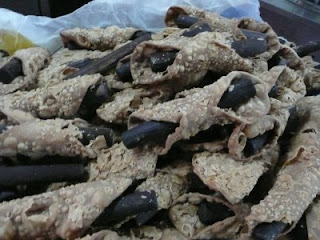
photo of Jude Witts

For the wafer (scorcia):

200 g of flour, 2 teaspoons of sugar, 20 gr. of lard, 2 tablespoons of Marsala, 2 teaspoons of cocoa, a pinch of salt.

For the filling:

1 kg of fresh sheep's ricotta cheese, 600 gr. sugar, 1 sachet of vanilla, dark chocolate little pieces, 100 gr. of candied orange peel.

Mix the flour with lard, the Marsala, sugar and a pinch of salt and mix well, you get a soft and compact dough. It stand for half an hour. Flatten the dough with a rolling pin and make thin squares of 10 cm per side, which wrapped diagonally around a cylinder of metal or a stick of wood.
Welded the flaps of the dough with a drop of water and fry in a frying pan in hot oil (or lard). Put in absorbent paper and expect to be cold before you very carefully remove the cylinder that keeps its shape.
Mix the ricotta with the sugar and vanilla. Put it in blender and then add the little pieces of chocolate and mix gently.

Finally fill the wafer of Cannolo with ricotta cream and garnish with slices of orange or candied cherries. Sprinkle the Cannoli with powdered sugar.

giovedì 15 gennaio 2009

Dreaming the sea...


These are pictures taken at the natural reserve of Capo Gallo, near Barcarello (Sferracavallo). A very nice path between Monte Gallo and the sea, near Palermo (10/15 minutes by car). When we want to relax a bit, let's go for a walk in this beautiful place to dream, makes us feel in touch with nature and with ourselves.
Soon after, however, we are going to eat a nice sandwich with panelle or the meusa, or a plate of spaghetti with clams or a risotto with seafood in the nearby village of Sferracavallo, because as I have repeatedly written, over the spirit also has important the stomach !
In the near post I will write something more about the natural reserves that surround us and the village of Sferracavallo, but now I see these pictures and expect a good day for the next walk ...